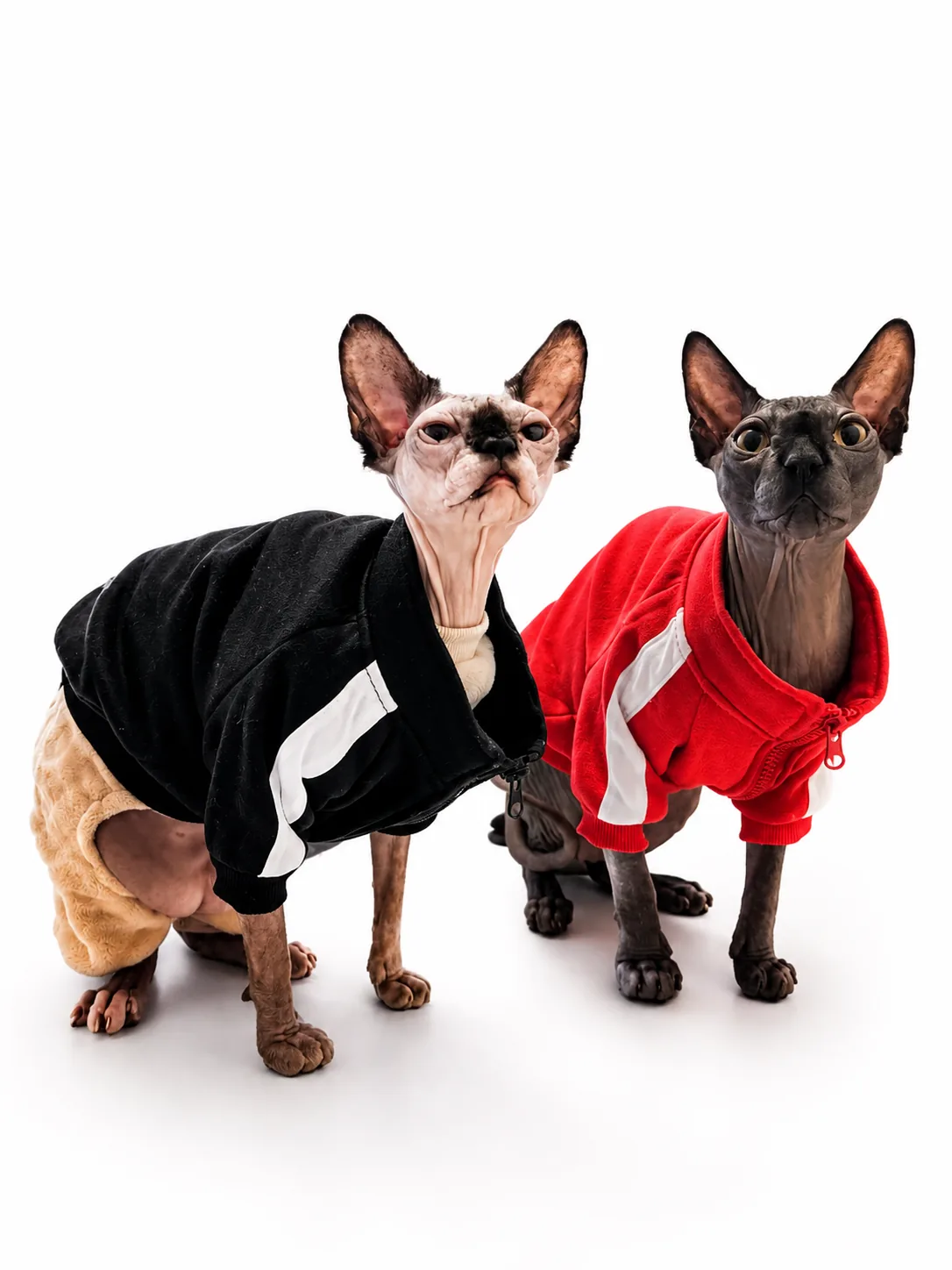
# Cat Jackets vs Cat Coats — What's the Difference and Which Does Your Cat Need?
Okay, I'm going to admit something.
When I first started nudiecats, I used the words "jacket" and "coat" completely interchangeably. They meant the same thing to me. Both were outerwear. Both went on the cat. Both kept them warm. Done.
It took a Sphynx owner asking me "is this a coat or a jacket, and which should I get for Melbourne winters?" for me to realise that actually — there's a meaningful difference, and getting it wrong means your cat either ends up overheated, under-dressed, or wearing something that doesn't match how they actually live.
After seven cats (three of them hairless, all of them opinionated), I've worked out the distinction. Let me save you the Google rabbit hole.
If you already know your cat needs outerwear, you can browse our cat jackets while you decide which level of coverage makes the most sense.
---
First — why this question even comes up
If you search "cat jackets australia" or "cat coats australia," you'll find the terms used interchangeably across almost every product page and pet store online. Most brands don't distinguish between them.
But here's what I noticed testing garments on my own cats: a piece designed as a jacket behaves differently on the cat's body than a piece designed as a coat. The cut, the coverage, the warmth level, and the situations each is suited for are genuinely different.
Once I understood that, I started getting much clearer on what each of my cats actually needed — rather than just grabbing whatever looked warmest.
---
What makes a cat jacket a jacket
A jacket is outerwear built for movement and moderate warmth. Think of it like the equivalent of a light puffer or a zip-up you'd throw on to run errands — not your heaviest winter coat, but definitely not nothing.
Cat jackets typically have: - A defined structure, often with shaped sleeves or panel seams - A zip, snap or velcro closure along the back - Moderate to high warmth depending on the filling or lining - A length that covers the torso but may not extend fully to the tail
They're designed for active wear — cats who move around a lot, go on outdoor adventures, or need warmth that works while they're walking, jumping, and exploring.
My Sphynx mix Dolly wears her Adventure Club Zip Jacket on cooler days when she's wandering around the house — it allows full movement and keeps her warm without restricting her at all.
---
What makes a cat coat a coat
A cat coat is fuller coverage, designed for sustained warmth — more like a heavy winter jacket or an overcoat than a casual layer.
Cat coats typically: - Are longer, covering more of the back and sometimes the sides - Provide a higher level of insulation (often padded or heavily lined) - Are designed more for stationary warmth — a cat resting, sleeping, or sitting still in a cold environment - Offer more protection from wind and elements if your cat goes outdoors
The tradeoff is sometimes a little less flexibility, which is fine for a cat who's mostly going to curl up somewhere warm rather than parkour across your kitchen.
The Winter Explorer Jacket sits at the heavier end of our range — it's structured, water-resistant, and built for genuinely cold conditions. I call it a jacket but it functions more like a coat in terms of warmth level.
---
So which one does your cat actually need?
This depends on three things: your cat's breed, your climate, and your cat's lifestyle. I'll break it down.
If your cat is a Sphynx, Devon Rex, Cornish Rex or other hairless/fine-coated breed:
These cats need both, honestly. They need a lighter jacket for everyday indoor use and a heavier coat or padded jacket for genuinely cold days, outdoor trips, or rooms that get very cold overnight. Browse the full cat jackets and coats range and build a small wardrobe — a light option and a heavy option is the minimum.
If your cat is a kitten:
Kittens regulate body temperature less efficiently than adult cats and feel the cold more acutely than most people expect — regardless of breed. A well-fitted lighter jacket is a great place to start. Check the sizing guide carefully because kitten sizing varies significantly.
If your cat is elderly or recovering from surgery:
Older cats lose body fat and muscle mass which reduces their ability to stay warm. A cat recovering from surgery needs coverage over the wound site as well as warmth. A coat with full back coverage is often the better choice here than a shorter jacket.
If your cat spends time outdoors:
A more structured, water-resistant jacket is worth the investment. Australian weather can turn — a sunny morning becomes a cold afternoon and if your cat is outside, you want them covered.
If your cat lives in a heated house and mostly stays indoors:
An everyday knit layer or a lightweight jacket is probably sufficient. You don't need heavy insulation if your home maintains a comfortable temperature — just something to take the chill off air-conditioned rooms or cooler nights.
---
The fit question — and why it matters more than you think
Here's what I've learned testing garments on my own cats across every season: the right warmth level is useless if the fit is wrong.
A jacket that's too tight around the chest will restrict breathing and movement. Too loose and it bunches, sags, or comes off entirely. Too short and the cat's lower back and hindquarters are exposed — which defeats the purpose if warmth is the goal.
For Sphynx and similarly proportioned cats, standard pet clothing almost always fails at the chest. Their chest is deeper and broader than a typical domestic cat — and most cat clothing is not cut for that.
Measure before you buy. The nudiecats sizing guide has a three-measurement process — chest girth, neck girth, and back length — and breed-specific notes because a Devon Rex sits differently in a garment than a Cornish Rex.
When in doubt, size up. A slightly loose jacket is always more comfortable than one that's pulling across the chest.
---
What about cat sweaters — where do they fit in?
Great question. Sweaters and knit jumpers are a third category that sits between a base layer and a jacket.
Think of a sweater as your cat's everyday warmth layer — ideal for indoor use, cool mornings and evenings, and temperatures that are chilly but not genuinely cold. A jacket or coat goes on top of that for outdoor use or seriously cold days.
My personal hierarchy for a hairless cat in Melbourne winter: pyjamas overnight, sweater through the day, jacket for outdoor trips or very cold rooms.
Browse the full cat sweater range if you're looking for that everyday layer.
---
The bottom line
Get a jacket if: your cat is active, needs everyday outerwear, or you want something that works across a range of temperatures.
Get a coat (or a heavier jacket) if: your cat is particularly cold-sensitive, you live somewhere with harsh winters, or you need sustained warmth for a resting or sedentary cat.
Get both if: you have a Sphynx, Devon Rex, Cornish Rex, or any cat who genuinely feels the cold — because different situations call for different layers, just like they do for you.
Browse the full cat jackets and coats collection and find what fits your cat's life.
New to nudiecats? Sign up to our list and get 10% off your first order. Your cat's wardrobe starts here.
*Letisha — co-founder, nudiecats, and owner of seven cats who have very different opinions about outerwear*
A few useful cat accessories to explore
These products are pulled from the current NudieCats catalogue. Check each product page for its current price, details and availability.